
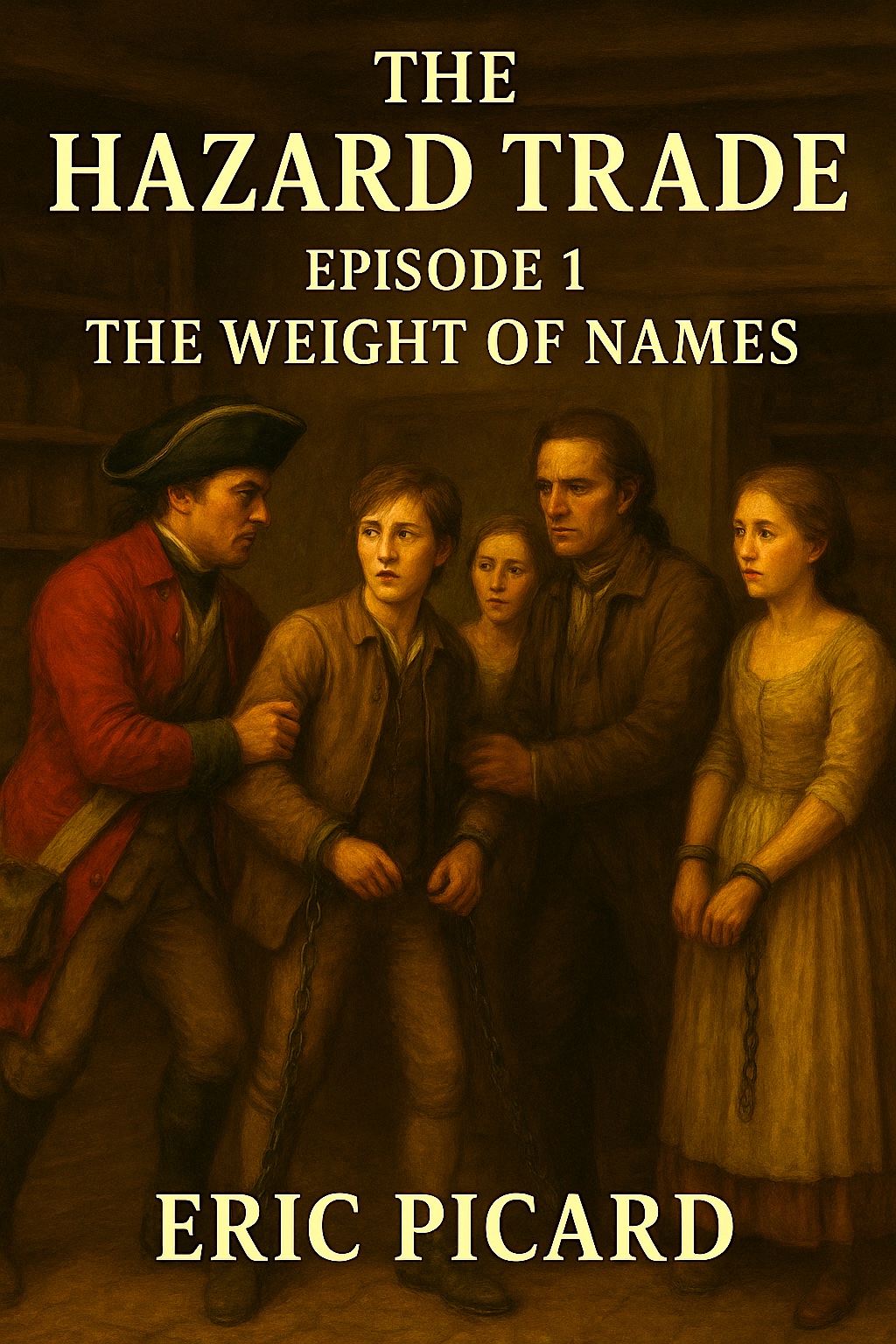
148 Years ago:
January 15th, 1778
The sergeant was back.
Benjamin Hazard pressed his forehead against the window frame. His breath melted a hole in the frost, showing the sergeant’s red coat that stood out against the gray morning at the corner of Thames Street and Bannister’s Wharf. Same position as yesterday. Same as the day before.
This morning the sergeant held a notebook.
Benjamin pulled back from the window. His feet found the cold floorboards. He reached for his stockings and pulled them on. His mother had knitted them by candlelight after the store closed. The yarn was rough but warm.
Downstairs, his father, William, sat at the desk beside the counter. Lines had carved themselves deep around his eyes these past two years. When he looked up, his smile didn’t reach those eyes.
“Fourteen years old today,” he said quietly. “Hard to believe.”
“That sergeant’s watching again.” Benjamin kept his voice low. “Same spot. He’s taking notes this time.”
The pen stilled against the page. “You’re certain?”
“He’s not hiding it anymore.”
The back door opened. Cold air came in with his mother. She set down her armload of wood. Her face was tight, as if she were waiting for bad news. She saw Benjamin and her face changed. She crossed the room and pulled him against her. He was much taller than her now, and he bent down to embrace her. He could smell soap and wool and something else that meant safety in an unsafe world.
“Happy birthday.”
“I smell molasses.”
She pulled back while holding onto him with her hands. Her eyes held a gleam that seemed to say that she’d already won an argument that hadn’t happened yet.
“Do you now? What makes you sure that this has anything to do with you?”
“Hope.”
“Hope springs eternal,” she said, smiling at him warmly.
“Thank you, Mother,” he said, giving her one final squeeze.
“If someone’s making birthday cornbread while British soldiers count our windows,” his older sister, Bridget, called from upstairs, “I’m coming down.”
His father looked up at the ceiling. “Your sister can smell trouble and molasses from equal distances.”
“Both useful skills,” Bridget said. They could hear her feet hitting the floor.
***
His mother went to the hearth and returned with cornbread. She cut it with the careful precision she’d learned as an indentured servant—the same precision that had carried her from bondage to merchant’s wife. His father took his piece and looked at it.
“The good molasses.”
“Yes.”
“We could have sold it for actual coin.”
“We could have.” His mother sat down. “But if we’re arrested today, and we might be, given that sergeant’s attention, I want our son to remember we chose to celebrate him even when we knew danger was coming. That’s the memory that will sustain him through whatever follows.”
His father smiled despite himself. “Your mother has a gift for making principle sound like strategy.”
“That’s because it is.” She broke her own piece of cornbread. “It’s the same reason you bought out my indenture contract when you barely had money for your own store; the same reason we don’t sell to the British commissary even though they pay premium prices; the same reason Thomas stopped speaking to us after we publicly became abolitionists, when his wealth depends on the slave trade. Principle isn’t complicated; it’s just expensive.”
Bridget came down the stairs and took a piece of cornbread. “If we’re going to be poor and principled, at least we’re well-fed today.”
Benjamin watched his parents look at each other—wordless communication that came from years of facing the world together. His father’s hands shook slightly as he broke his cornbread. His mother’s accent was getting thicker. It always did when she was afraid.
“Three days of watching,” his father said quietly. “And now he’s taking notes. That’s not casual patrol.”
His mother’s fingers stopped moving. “Do we need to—”
“What? Run? We’re merchants. We sell provisions. We haven’t done anything wrong.”
“Thomas stopped by last week,” Bridget said. She had a thoughtful look on her face. “Asking about our suppliers and our delivery schedules. I thought he was just making conversation.”
The temperature in the room dropped.
“Why didn’t you mention this before?” his father asked.
“Because I thought I was being paranoid. But now …” She gestured toward the window where the sergeant stood watching. “Now I’m not so sure.”
***
As they cleaned up from breakfast, the front door opened, and its bell chimed. Too early for customers. Too early for anything good.
Duchess Quamino came in with her basket of pastries. She was a slave of the Channing family, but was allowed to run a small catering business in which she would share the profits with her master. She was also a good friend to the Hazards. The smell of cinnamon and nutmeg filled the store. Her presence brought warmth that pushed back against January’s bite and something else: a grinding fear.
“Benjamin Hazard.” Her voice carried strength that belied her circumstances. “Fourteen years today. That deserves proper recognition, even in times like these.”
She produced a cake wrapped in clean linen. Frosted plum cake that had made her famous among Newport’s elite. At a time when sugar had become more valuable than silver, this represented extraordinary sacrifice—ingredients she could have sold for desperately needed coin, choosing instead to celebrate a boy’s passage toward manhood.
“Duchess, you shouldn’t have—” his mother began.
“Birthdays matter.” But something brittle lived underneath the warmth now, something that hadn’t been there six months ago. “Besides, Mistress Channing ordered extras for a gathering that was postponed. Better to share joy than waste good ingredients.”
She arranged her remaining pastries on the counter with practiced efficiency, but her hands trembled. When his mother moved closer with the instinct of one woman recognizing another’s distress, Duchess’s composure wavered.
“Had word from John three days ago,” she said quietly, glancing toward the door to ensure no customers were approaching. “He’s well, praise God. His captain treats his crew fairly, pays them proper shares. But every day he’s at sea is another day I wake wondering if this is the day I get different news.”
“John’s smart and capable,” his mother said. “He’ll come home.”
“Will he?” Duchess’s hands stilled on the pastries. “Every prize he takes at sea is blood money, Mary. Money to buy what shouldn’t need buying. Our freedom.” Her voice dropped even lower. “Charles asked me last night when Papa’s coming home. He’s six years old. How do I explain that his father is risking his life privateering to earn money to purchase his own family? That we might lose him trying to win our liberty?”
She pressed her fingers against the counter, and Benjamin saw the cost of maintaining her dignity every day: serving people who saw her children as property, smiling through the fear that gnawed at her every waking moment. Her husband, John Quamino, had won enough money in a lottery several years ago that he was able to purchase his own freedom. But he worked in one of the only positions that a free African man had where he had the opportunity to make enough money to buy the freedom of his family.
“If he doesn’t come back …” She couldn’t finish the thought. “I’ll have to find another way. Years more of bondage while I scrape together coins from frosting cakes for men who think I should be grateful for the opportunity.”
His mother reached out and squeezed her hand. For a moment, two women who had both known bondage—one through indenture, one through slavery—stood together in silent understanding of costs that free people could never fully comprehend.
Duchess straightened, forcing brightness back into her voice. She focused on Benjamin again. “Use this year wisely, young man. These are times that forge character. What we become in darkness reveals who we truly are.”
After she left, Benjamin stood holding the precious cake, understanding he’d received more than a birthday treat. Her courage was something he was only beginning to comprehend.
“She’s remarkable,” he said quietly.
“She is,” his mother agreed. “And John Quamino is braver than most who call themselves soldiers. Fighting for your family’s freedom when the law says they’re not even yours to fight for—that takes a kind of courage I can barely imagine.”
***
Benjamin went to the backyard to split wood. January air bit at his exposed skin. He positioned a log on the chopping block and raised the axe, but movement through the gap between buildings caught his eye.
A figure in a heavy woolen cloak stood against the brick wall of the warehouse on Bannister’s Wharf, two blocks distant. Not watching the way the sergeant had watched; this was different. The man’s posture suggested alertness, readiness. As if he were standing guard rather than gathering intelligence.
Benjamin brought the axe down. The crack echoed between buildings.
When he looked up, the figure had shifted position but remained visible; deliberate, as if he wanted to be seen but not identified. The cloak’s hood shadowed his face, but something about his bearing suggested strength, competence, protection.
Benjamin split another log. The figure still watched.
He stacked the wood carefully, his mind racing. Two different kinds of watchers: the sergeant’s obvious surveillance, building a case against them, and this other presence that felt like a guardian angel hiding in shadows.
He didn’t know which frightened him more.
***
When he came back inside, stamping snow from his boots, the bell chimed again.
Newport Gardner entered, moving with the careful dignity of a man who understood exactly how much space he was permitted to occupy in the world. His fingers tapped complex rhythms against his leg as he approached the counter, unconscious, like a musician hearing melodies no one else could detect.
“Mr. William, Mrs. Hazard.” His voice carried the musical cadences of the Gold Coast, vowels that rose and fell musically. “Young Benjamin. Fourteen years today.”
He paused. Those restless fingers still tapping. “The same age I was when I was taken into Master Gardner’s household.”
His father was already gathering supplies: flour and salt for Newport’s master, the familiar rhythm of their unspoken arrangement. “What brings you out so early?”
“Master Gardner is planning a reception. British officers want everything proper for an important visitor arriving next week.”
Newport’s voice remained carefully neutral, but his eyes flicked toward the windows, checking for observers. “They discuss such things freely while I tune the harpsichord. A musician becomes invisible while visible.”
He moved closer to the counter. His voice dropped to barely above a whisper. “But mostly I came to share word. Mrs. Tillinghast stopped me on Thames Street this morning. She’d heard a newly arrived sergeant has been asking questions about specific families. Yours among them. Detailed questions: delivery schedules, customer lists, and family connections. She thought you should know before the day’s business begins.”
“Any idea what prompted this interest?” his father asked, equally quiet, his hands continuing their work—the performance of normalcy that had become survival in occupied Newport.
Newport accepted the package his mother offered. He paused. “Major Ashworth told Master Gardner that the new provost sergeant has a particular talent for identifying ‘merchant families who hide their sympathies behind commercial neutrality.’ Those were his exact words. And then he mentioned your name, Mr. William, along with two others. The Overings and the Robinsons. Both have already been visited by soldiers this week.”
His father’s hands stilled on the package he was tying off. “I see.”
Newport lifted the smaller bundle his mother had prepared—cornmeal for Johnnycakes, one of her “extras” that had become legendary among Newport’s struggling households, distributed without regard to the color of the recipient’s skin. A dangerous kindness in a city where such things were noticed and remembered.
“Much obliged, Mrs. Hazard. My master will appreciate the quality of your goods as always. I will appreciate the johnnycakes.” He paused at the door, glancing back to ensure no one was within earshot on the street. When he spoke again, his voice carried something more personal, more raw. “Be careful today. All of you. When provost sergeants take notice of you, they already know what they’re looking for. They’re just building the case to make the arrest look proper.”
After he left, silence hung heavy in the store.
“The Overings and the Robinsons,” his mother said quietly. “Both had soldiers search their premises this week. Both were questioned about their suppliers and associations.”
“And both were released without charges,” his father said, but his voice carried no relief. “Which means either they satisfied the British or—”
“Or they’re building toward something bigger,” Bridget finished from her position near the stairs. “Using the smaller fish to catch the larger ones.”
Benjamin stared at the door Newport had just exited. “Why did he risk coming here? If they’re watching us, if they’re building a case—”
His mother was wrapping the extra cornmeal with trembling hands, her movements precise despite the fear. “Because some gifts are dangerous to give, love. Especially for those who have so little freedom to give anything at all. What he just did—coming here, warning us when he could be seen—that’s trust. The kind that could cost him everything.”
She looked at Benjamin. “Remember that. Remember who risks what, and for whom. That’s the measure of a person—what they’re willing to sacrifice for others when they have so little to spare.”
***
The morning brought a trickle of customers. Each one carried fragments of disturbing news woven into ordinary transactions.
The door opened again. Joseph Wanton entered. His boots clicked against the floorboards with the precision of a man who expected the world to accommodate his presence.
The former governor’s son carried himself with rigid authority. He was a fierce loyalist, although many felt only because his shipping business relied on the British Navy’s protections. His pale eyes scanned the inventory with the assessment of someone cataloging assets.
“William. I require candles. Good ones, not the tallow drippings most establishments are reduced to selling.”
Benjamin’s father gathered beeswax candles. Wanton examined them with expert fingers that had once managed one of Newport’s most successful merchant houses.
“These are actually quite fine. Better than Robinson’s been offering the garrison.” The admission seemed to irritate him. “Thomas speaks often of how family names once commanded universal respect in Rhode Island. Such a pity when certain branches choose questionable associations.”
Benjamin caught the emphasis on ‘Thomas.’ His father’s cousin. Who had always treated their family with barely concealed contempt. Who had stopped by last week asking about their suppliers, their schedules.
“How many will you need?” his father asked, voice carefully neutral.
“A dozen. Major Ashworth appreciates proper illumination during his correspondence. General Pigot has given him considerable latitude in security matters, and he writes extensively about Newport’s remaining challenges.” Wanton’s gaze swept across the family, lingering on each face as if memorizing them. “Thomas has provided Major Ashworth with considerable insight into Newport’s social dynamics. The Major values such civic cooperation.”
He counted out coins with deliberate slowness, each clink against the counter like a small verdict. “The Hazard name still carries weight, William. I trust you’ll remember that when difficult decisions must be made about family loyalty.”
He paused at the door. “Those candles truly are exceptional quality. Whatever else I think of your choices, you’ve never compromised on merchandise. I do hope you’ll remember that reputation matters, even in difficult times.”
After the door closed, the store felt poisoned.
“He knows,” Bridget whispered.
“Knows what?” his father asked, though his face had gone pale.
“Whatever’s about to happen. That wasn’t a threat. It was a farewell. He was saying goodbye to the store, to the merchandise, to …” She gestured helplessly. “To the way things used to be.”
They didn’t have long to wait.
***
The front door crashed open. It bounced against the wall hard enough that dust scattered from the impact and a small crack appeared in the plaster.
A tall blond lieutenant strode in with two privates flanking him. He stopped in the center of the room with military precision, boots planted, shoulders back; every inch of him radiating the authority of His Majesty’s armed forces.
“Lieutenant Reginald Fairfax, by order of Major Ashworth. This establishment is subject to immediate search for seditious materials.”
His Virginia drawl was sharp. Everything about his bearing spoke of gentry who saw the Revolution as mob rule, who believed order required hierarchy and hierarchy required force.
Behind him came the sergeant Benjamin had been watching for three mornings. He moved with predatory grace, carrying the rough authority of a man who had earned his rank through twenty years of service rather than purchase or family connection. His pale green eyes swept the store, cataloging details he’d clearly studied during his surveillance.
“Sergeant MacReady,” Fairfax said. “Search the premises. Thoroughly.”
“Of course, Lieutenant.” Highland accent, rough as granite. MacReady’s gaze settled on Benjamin for a moment, assessing, calculating, then moved on.
“How may we assist?” William stepped forward. His hands were visible and non-threatening, the posture of a man who understood that cooperation was survival.
“Through silence and cooperation.” Fairfax’s gaze found Benjamin’s mother. Lingered with calculated insult. “Mrs. Hazard. Irish-born, I understand? Catholic? Known abolitionist sympathies? I trust you understand the importance of demonstrating proper loyalty to legitimate government, particularly given your … background.”
“We serve Newport’s residents according to our conscience.” His mother’s voice stayed level, but her Irish accent was thickening.
“Conscience doesn’t supersede lawful authority, Mrs. Hazard. These are dangerous times for philosophical luxuries.” Fairfax gestured to his men with sharp precision. “Sergeant MacReady, search everything.”
MacReady gestured to his men with crisp efficiency. “Grimsby, Morrison, search the premises.”
The two privates moved through the store like locusts, overturning crates and barrels that represented the family’s survival, scattering merchandise across floorboards with aggressive enthusiasm.
Private Morrison—thick-set with scarred hands and the build of a man who’d spent his life doing hard labor—worked his way toward the back with focused attention. He wasn’t searching randomly. He moved with purpose, ignoring some areas entirely while focusing on others with careful attention.
Bridget caught it before anyone else. She’d been watching from the stairs, her sharp eyes tracking Morrison’s progress. “He knows where he’s going,” she whispered to Benjamin. “He’s not searching. He’s retrieving.”
Benjamin watched Morrison’s progress with growing dread. The private moved past crates of salt pork, barrels of flour, shelves of candles and soap. All the places you’d hide something if you were actually hiding something.
He went straight to the wooden crate marked “CORNMEAL – BOSTON” in black stenciled letters.
Didn’t hesitate.
Grabbed the crate.
Hurled it against the wall with deliberate force.
The impact jarred the lid loose, a sharp crack that echoed through the store like a gunshot.
White cornmeal spilled across the floor in a cascade of pale grain.
And something else.
Papers scattered like fallen leaves, covered with columns of numbers and letters arranged in careful patterns that clearly represented some form of code.
Benjamin stared at the documents. The crate had arrived yesterday; he’d helped unload it himself, but something had been wrong. The weight when he’d lifted it. The way it had settled unevenly when they’d set it down. At the time he’d thought the cornmeal had shifted during transport.
Now he understood. Someone had opened it. Added those papers. Resealed it so carefully he hadn’t noticed.
It was someone who knew their routines intimately, someone who had access to their suppliers, their delivery schedules, and their inventory management.
MacReady was beside the spilled crate in two quick strides. He lifted the sheaf of papers from the pile of cornmeal on the floor with careful attention, holding it up to the lamplight.
“Coded communications, hidden in routine supplies with systematic care. This suggests regular intelligence operations, not isolated incidents.”
“I’ve never seen those papers before.” Benjamin’s father’s voice cracked with genuine bewilderment. “I don’t know what they are or how they got there.”
“Without your knowledge?” MacReady’s eyebrows rose with practiced skepticism. “In your own store? In a crate that arrived under your supervision yesterday?”
“Yes. I don’t know how they—”
“Perhaps you’re simply more clever than most traitors, Mr. Hazard. Or perhaps you’re telling the truth and someone has been very helpful in ensuring these documents found their way to your establishment.” MacReady examined the papers more closely, his rough fingers tracing the coded text. “Either way, the evidence speaks more clearly than protestations. These aren’t amateur scribblings. This is professional intelligence work.”
MacReady flipped through the pages. The top few were formatted like a ledger, in carefully drawn block letters. But the contents of the ledger were not words, they seemed encoded by some cipher. Then he found one that wasn’t enciphered; he studied it carefully.
Benjamin caught sight of the handwriting. Not printed, not anonymous, but careful script that he’d seen on invoices, correspondence, documents that had passed through their store regularly over the years.
His hands went numb.
The room tilted slightly.
He tried to speak but his throat had closed.
The handwriting was Thomas’s, his father’s cousin, who had always treated their family with barely concealed contempt, who had stopped by last week asking about their suppliers, their delivery schedules, and who moved in Joseph Wanton’s circles and had access to their store, their routines, their vulnerabilities.
Benjamin looked at his father. His father hadn’t seen it yet. Didn’t know what Benjamin knew, still thought this might be some terrible mistake that could be explained, corrected, survived.
Morrison produced iron shackles with casual efficiency. The metal gleamed dully in the lamplight, catching and reflecting the morning sun that streamed through the windows.
“William Hazard, Mary Hazard, you are under arrest for sedition and conspiracy against His Majesty’s government.”
Benjamin watched the shackles close around his father’s wrists. The sound they made: metal clicking into place, the slight rattle of chain. The iron was cold enough that his father’s wrists jerked back involuntarily, but Morrison’s grip was stronger.
Iron closed around his mother’s wrists next. Mary Sullivan Hazard, who had arrived in Newport as an indentured servant and built herself into a respected merchant’s wife through intelligence and determination, who had convinced his father to avoid the slave trade even when it meant they lived one step closer to poverty, and who had organized women for boycotts and operated as a message center because she could read when many couldn’t.
“Please.” Benjamin heard his own voice though he hadn’t planned to speak. “They’ve done nothing wrong. We’re just merchants trying to survive.”
“Just merchants don’t hide coded intelligence in their inventory.” MacReady studied the papers with professional interest. “Evidence speaks clearer than protestations, boy. Your parents have been running intelligence operations for months, perhaps years. These documents prove systematic coordination with rebel forces.”
Fairfax smiled with cold satisfaction. “The children will be detained as material witnesses. Their interrogation regarding their parents’ activities will be comprehensive and thorough. Major Ashworth has particular interest in understanding how long this operation has been functioning.”
The word ‘interrogation’ hung in the air, carrying implications that made Benjamin’s blood turn to ice.
MacReady examined the coded papers once more, then made his decision. “Lieutenant Fairfax, I recommend we arrest the children as well. Material witnesses to their parents’ activities. Children often remember details their parents think they’ve hidden. Their testimony will be valuable during examination.”
Benjamin’s mother had remained controlled through the search, the destruction, even her own arrest. But when she realized her children were about to disappear into British custody, something broke.
She didn’t scream.
She went cold.
When she spoke, her voice carried sounds Benjamin had never heard from her before: words that weren’t English, weren’t anything he recognized.
“Ná bain dóibh, le do thoil. Tá siad óg. Níl a fhios acu faic.”
Then English, but the accent so thick it was almost another language, the accent of her childhood before she’d learned to control it for Newport society: “They’re only children. Whatever you think we’ve done—whatever someone has told you we’ve done—they had no part in it. They know nothing. Please. Le do thoil. Please. They’re too young for this. Benjamin is only fourteen.”
Morrison’s hands hesitated on the shackles. Private Grimsby glanced at Fairfax as if seeking permission to feel human.
But Morrison continued his advance methodically. The shackles gleamed in the lamplight as he moved toward Benjamin and Bridget.
Benjamin stared at those papers in MacReady’s hands. Thomas’s handwriting: his cousin’s careful script on documents that would destroy them all. His father still hadn’t seen it. Still didn’t understand who had betrayed them. Still thought this might be some terrible mistake.
This wasn’t random. This wasn’t accident. This was family deciding that the broader Hazard name mattered more than this branch’s survival. Thomas choosing his social position over their lives.
The shackles gleamed as Morrison reached for Benjamin. Bridget stepped forward instinctively, placing herself between her younger brother and the soldier: a protective gesture that earned her a warning look from MacReady.
Through the window, Benjamin caught a glimpse of that cloaked figure from the alley. Still watching. Still waiting.
But for what?
The story continues in Episode 2. “The Magnificent Rescue”
Access more Episodes here:
https://www.amazon.com/dp/B0G3XYC8JK
Copyright Eric Picard – 2026
 Eric Picard